The story

Just be real with me.

After vanishing for a week, Jordan finally sits down to explain himself to his girlfriend. The truth involves his con-artist father, six stolen gems, and the fact that he can now move things with his mind. She would believe almost anything else.

Short synopsis

Jordan has been gone a week. Val wants one thing: for him to be real with her. So he is. He has telekinesis. She does not believe him, so he tells her the other true story, about his father, six stolen opals, and a motel fight he still cannot explain. She believes that one. Neither of them notices the man at the table behind him.

Synopsis

In three parts

  1. Jordan on the apartment floor with the gem

    Part 1

    The door

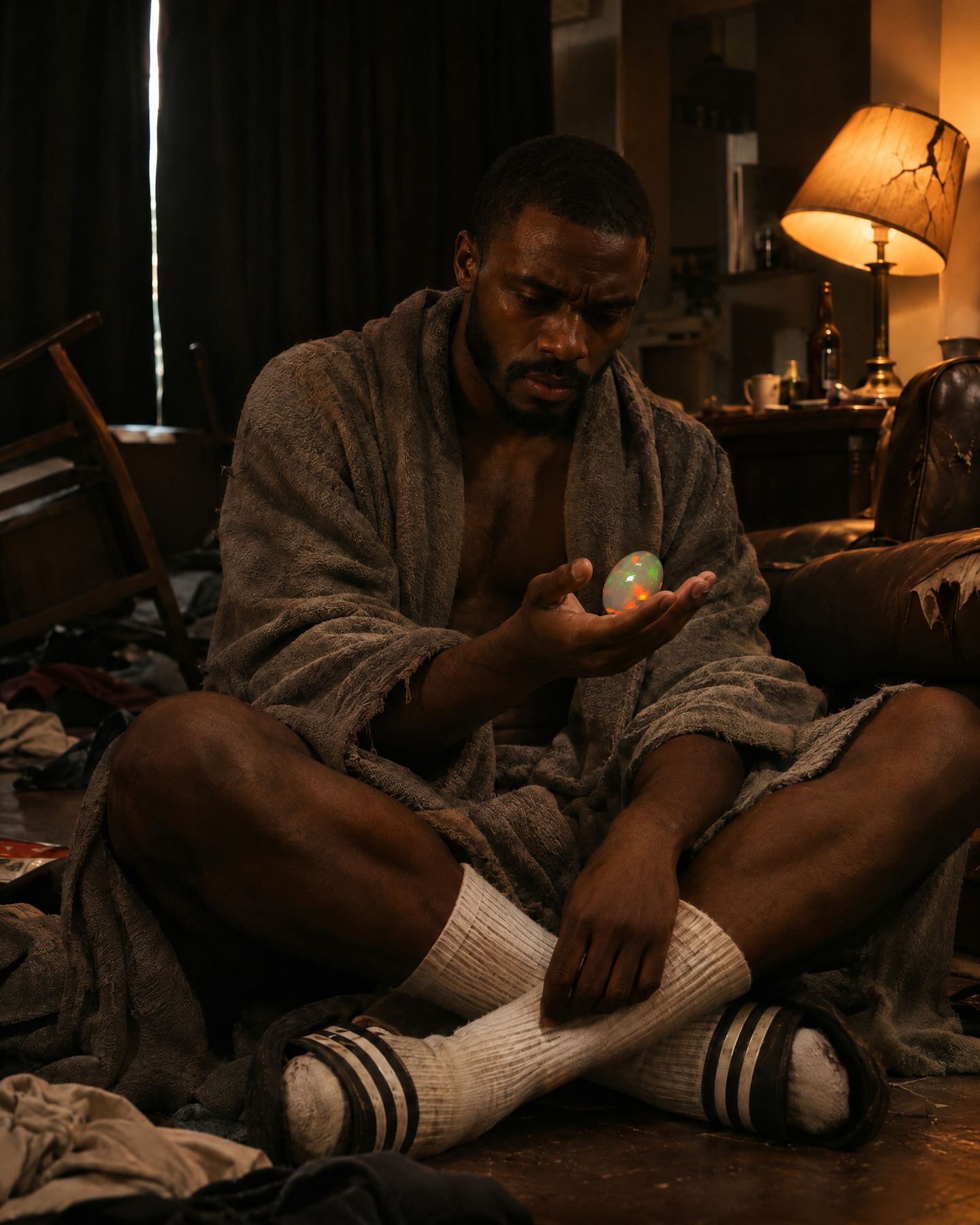
    Jordan (29) sits cross-legged on the floor of a wrecked studio apartment, blackout curtains drawn, staring at an opal the size of a golf ball in his palm. Someone is knocking. It is Val (26), his girlfriend of seven months, and she can hear his phone buzzing through the door. He has not answered her in a week.

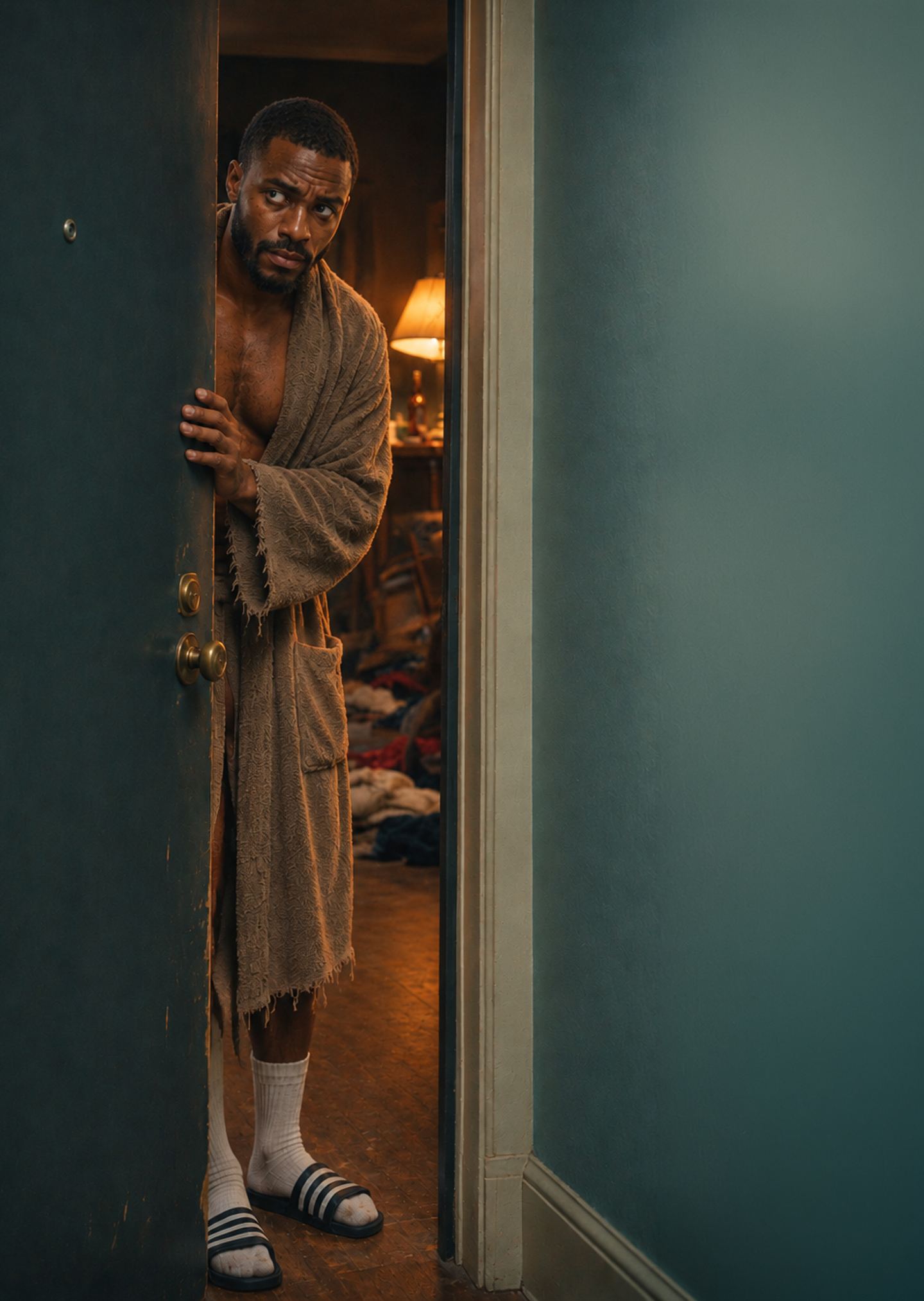
    He answers the door in a bathrobe and Adidas slides and scans the street like he is expecting a hit squad. He will not let her inside. He will, however, let her drive him two blocks to a cafe, because no one walks in LA.

    On the radio: a hooded vigilante with "superhuman" strength just took down four armed men downtown. Jordan goes very still and stares out the window. Val changes the station.

  2. Val leaning in across the cafe table

    Part 2

    The seat facing the door

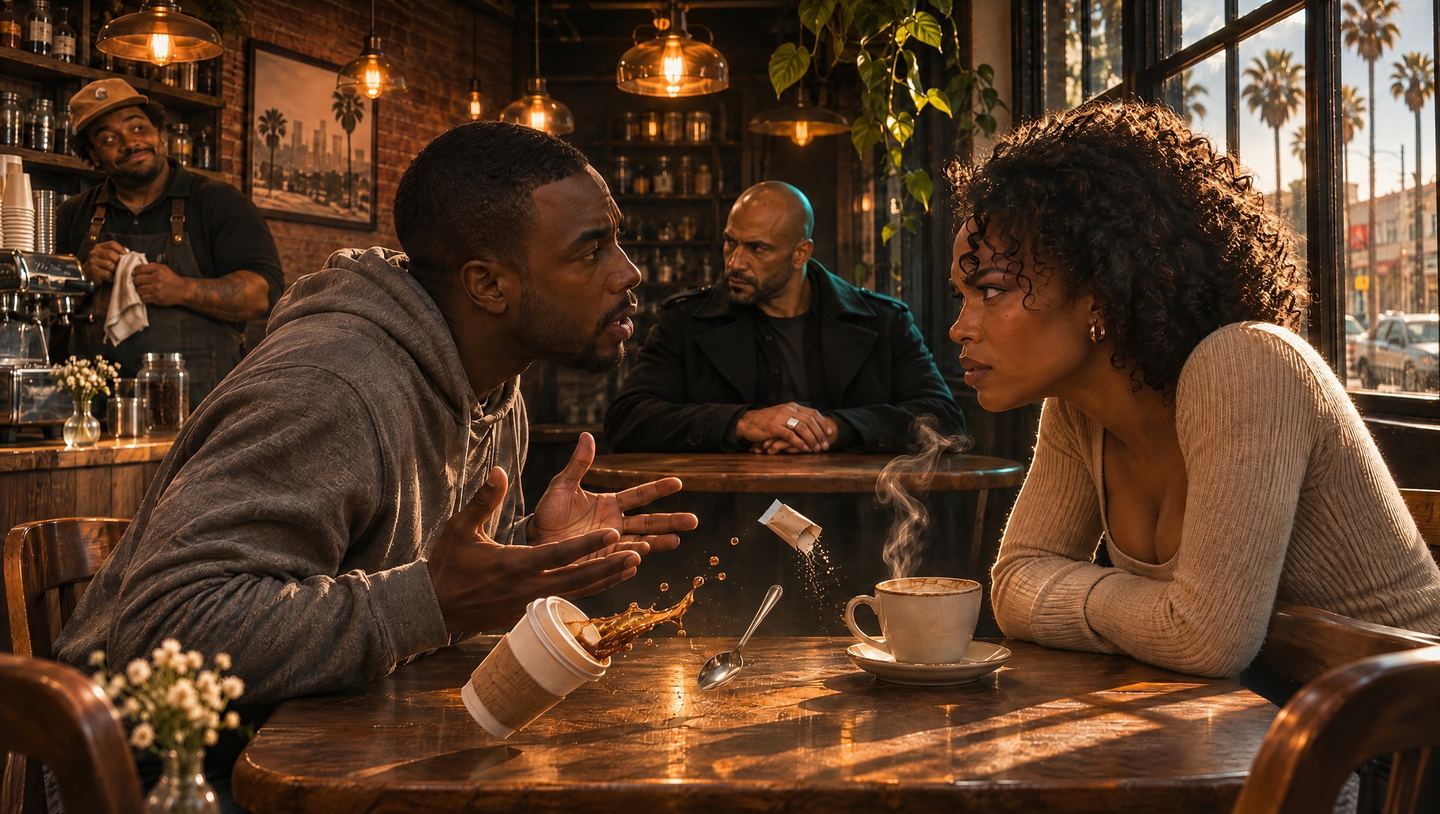
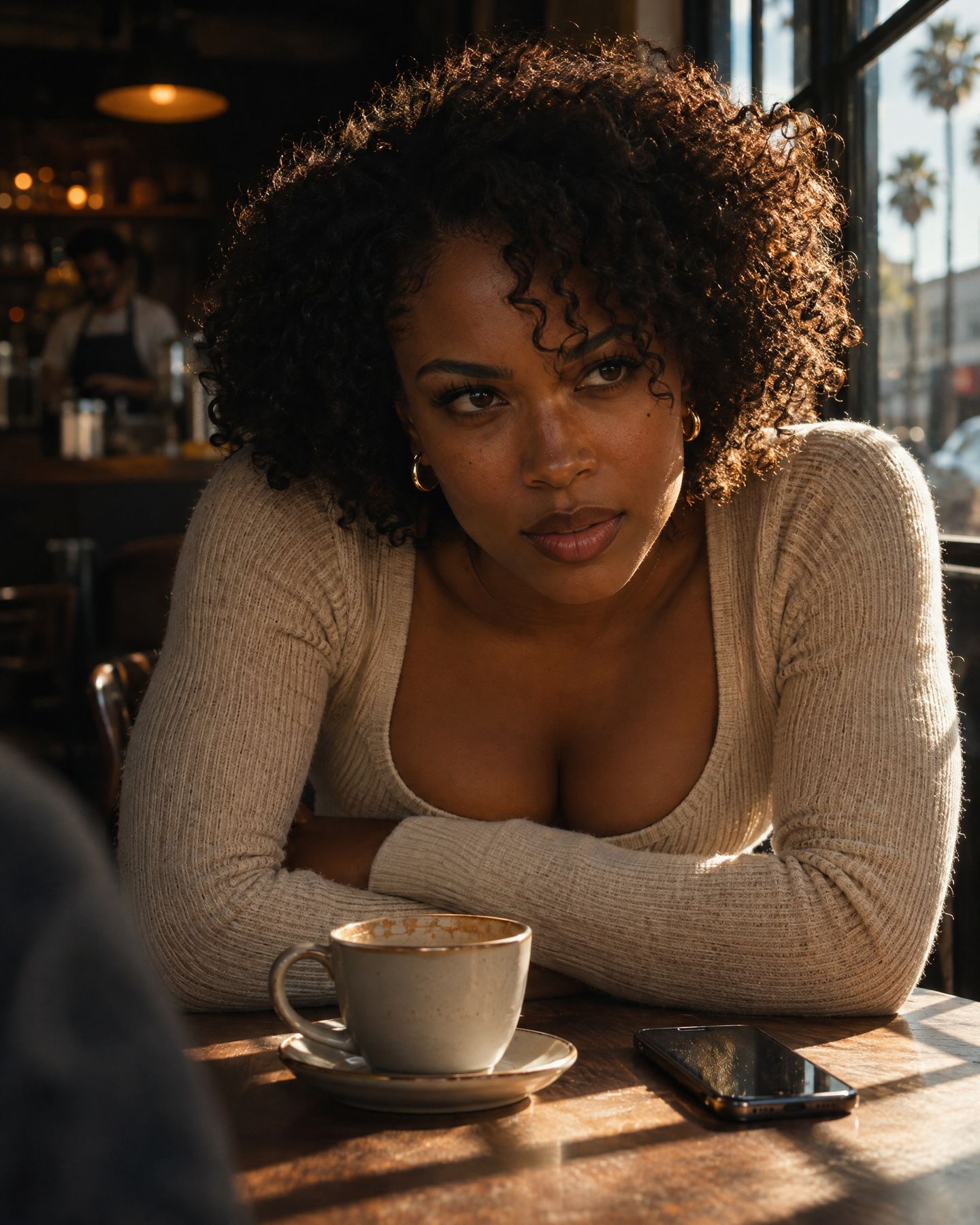
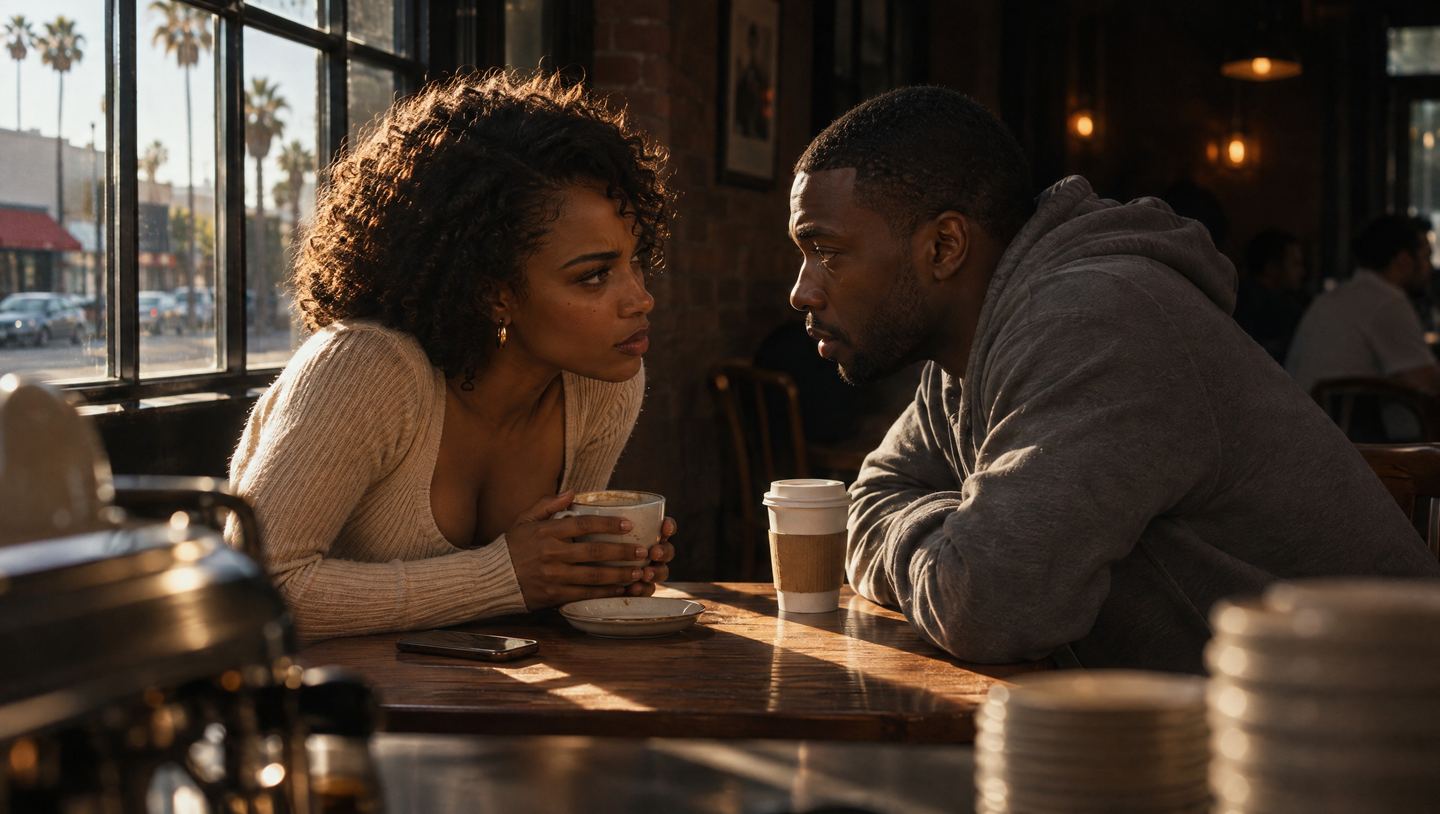
    At the cafe, Jordan insists on the seat facing the door. Val has had it. She wants one thing: for him to be real with her, the way he always was. The Barista, a middle-aged Black man with opinions, keeps inserting himself and keeps eavesdropping.

    So Jordan is real with her. He has telekinesis. Also super speed. Also he has gotten stronger.

    Val cries. Not because she is scared. Because she thought something horrible had happened to him, or that he had left her, and instead he is doing a bit. "Do you have any idea how hard it is to find a Black guy in LA who has his stuff together and wants to be with a Black woman?" "It's rare, brah," offers the barista.

  3. The frozen cafe, Ali at the table behind the empty chair

    Part 3

    The first one

    So Jordan tells her the other true story. His father, Thadios, came back to town with six rare opals from Ethiopia and people chasing him, and asked Jordan to drive him to Vegas and Portland. Told in hand-drawn anime, we watch Thadios drop two armed men in a motel doorway in under ten seconds. He is fifty-something. He gave Jordan one of the gems and told him to ditch his phone.

    Val believes this version. She has to get to work. He promises to answer when she calls.

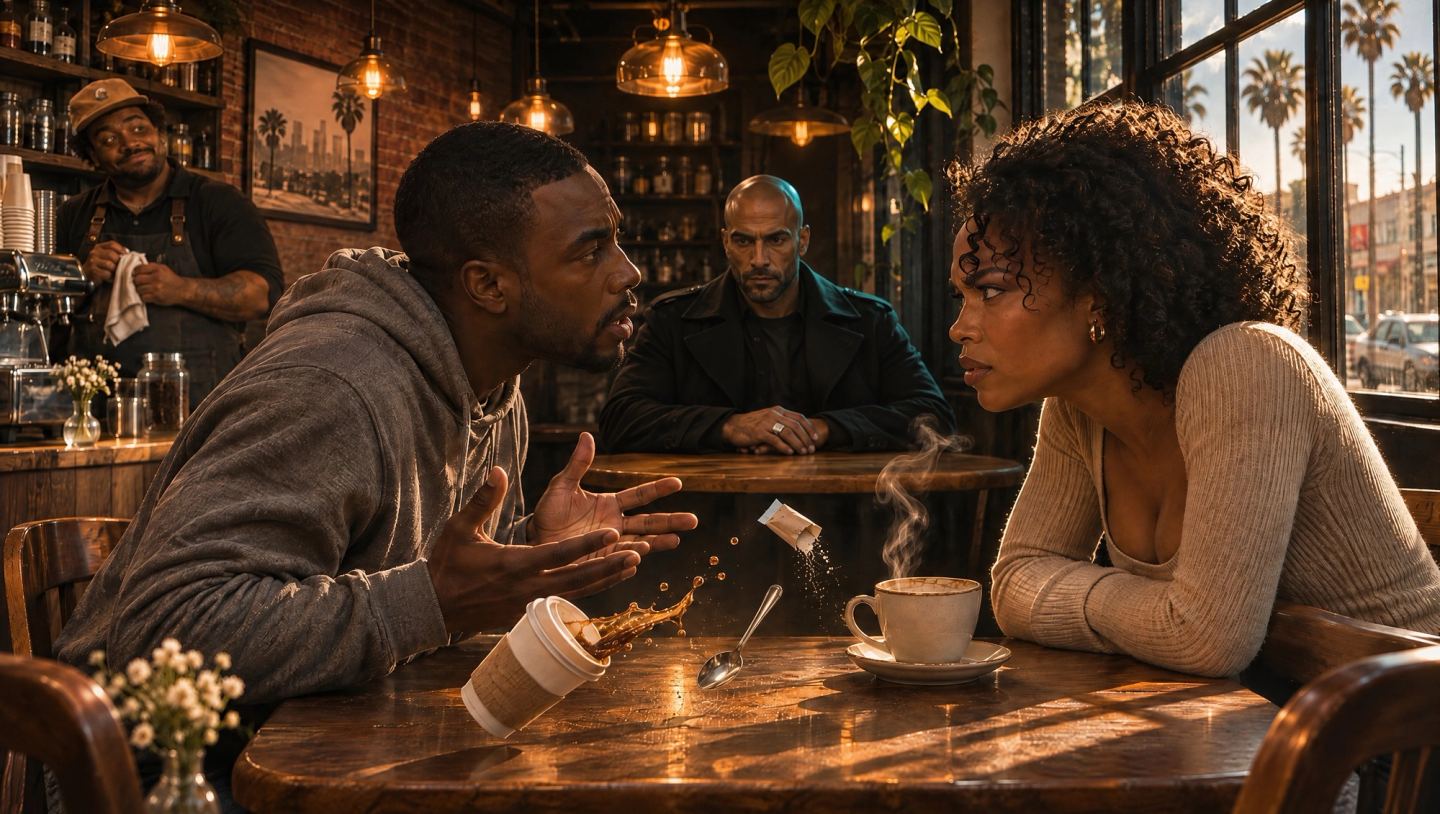
    Alone, Jordan watches the barista bear-hug his girlfriend at the counter, shakes his head, and with a flick of his eyes sends his empty cup across the room into the trash. By the time they turn around, he is gone. Then everything stops. Mid-laugh, mid-motion, the room freezes. A man, Ali, fades into view at the table directly behind Jordan's empty chair. He has been there the whole time. He dials. "I've found the first one."

The world

Tone, look, sound, city

01

Tone

Between Atlanta and Chronicle
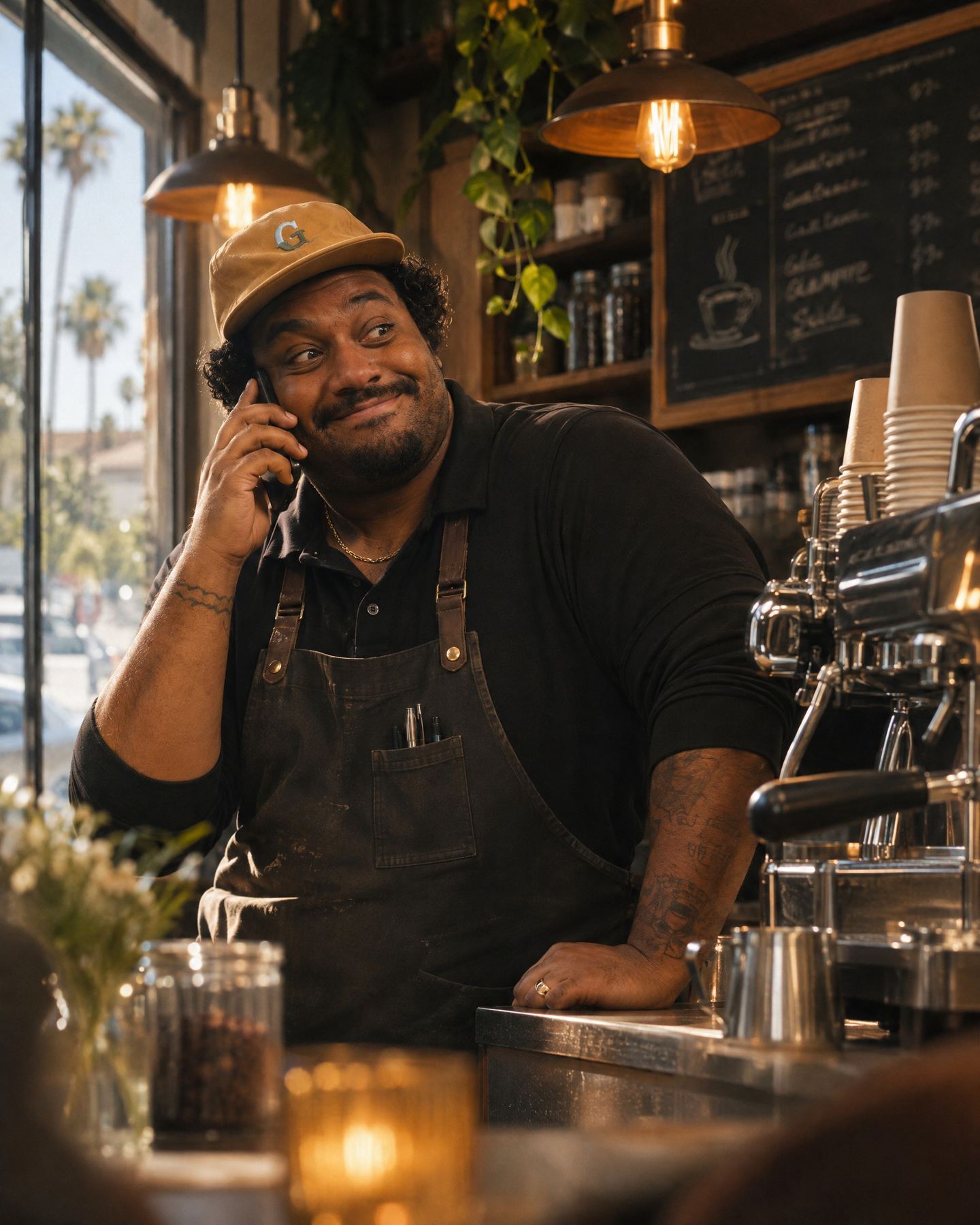
The barista, pretending not to listen

Super Sus lives in the space between Atlanta and Chronicle: a Black Los Angeles relationship comedy, played straight and intimate, that keeps getting interrupted by a superhero origin story it refuses to take seriously until it has to.

The comedy comes from behavior, not jokes. A man in a bathrobe scanning the street. A man who needs the seat facing the door. A barista who has decided he is the couple's therapist. The drama comes from a simple, recognizable ask: just be real with me. And the genre comes in sideways, through a radio report nobody reacts to, a dad who can fight, a coffee cup that should not move.

By the last shot, the audience realizes they have been watching the pilot of something much bigger.
02

Visual style

Grounded, warm, and close

Jordan and Val seen from the counter

Natural and practical light: the one lamp in Jordan's apartment, the window in the cafe, the fluorescent bath of a motel corridor. Skin tones rendered with care; dark skin lit for depth, not flattened. Handheld but patient, letting two-shots breathe so the actors can play the awkwardness.

The frame is often watched: doorways, windows, over-the-shoulder from the counter. The audience should feel, before they know why, that someone is listening.

03

Sound & music

Silence is the joke

Jordan through a half-open door

No music in the car, just an NPR anchor. The cafe runs on room tone and the espresso machine; the barista's interruptions land because the sound design keeps him present even when the camera does not.

Score arrives exactly twice. Once as a swell that mirrors Jordan's "I've developed some... abilities" and deflates with Val's "Who the hell's Magneto?" Once, for real, at the time-freeze: a single low tone that hangs until Ali speaks.

04

Los Angeles

Two blocks wide

The cafe window, palms outside

Three locations, all within two blocks: a studio apartment with blackout curtains, a quiet corner cafe, and the inside of Val's car. The city exists in the radio and the dialogue. That restraint is deliberate. The short is a chamber piece; the series opens the map: Downtown, Skid Row, Vegas, Portland, Addis Ababa.

Comparable films

Small story, big genre

  • Sleight

    2016

    A Black LA street magician with a real power, told as a grounded relationship drama. The closest cousin in tone and scale.

  • Chronicle

    2012

    Teenagers discover telekinesis; the powers are a pressure test on friendship before they are a spectacle.

  • Atlanta

    2016–2022

    The tonal north star: naturalistic Black comedy that bends into the surreal without announcing it.

Director's statement

Why this film

Bem Yemesgen, writer and director

Every superhero story is a story about a secret. What drew me to Super Sus was not the telekinesis. It was the conversation that happens around it: a man trying to be honest with the woman he loves, and discovering that the truth is the one thing she cannot take from him.

I wanted to make a film about Black men and vulnerability that does not lecture, so I put the lecture in the mouth of a barista who does not follow his own advice. I wanted to make a film about fathers and sons, so I gave Jordan a dad who is charming, unreliable, and, it turns out, dangerous. And I wanted to make a film about Los Angeles that takes place in a car, an apartment and a cafe, because that is the LA I know: two blocks wide and full of people listening in.

The anime sequence is the heart of the design. Jordan processes his father the way a lot of us process the people we cannot figure out: as a story, a little exaggerated, a little mythic. Switching mediums lets the audience feel that, and lets a short film show a world much bigger than its budget.

Super Sus is a proof of concept. The short ends where the series begins: with a man who has powers, a girlfriend who does not know, a father on the run, and a hunter who has just found the first one.